Friday, January 24, 2014

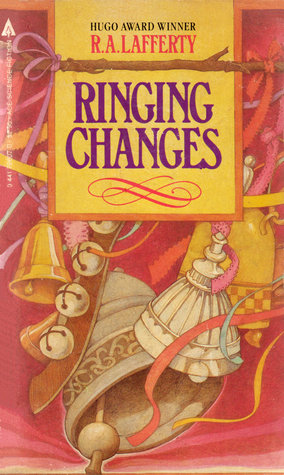
Ringing Changes 1: Parthen

For some reason, Ringing Changes (1984) is an often overlooked collection of Lafferty stories. It is not as even in quality as Nine Hundred Grandmothers, but it contains some of his greatest stories. Any collection that contains “Parthen,” “Old Foot Forgot,” “Days of Grass, Days of Straw,” and “Been a Long, Long Time” is a major collection. The fact that this was a readily available paperback may have helped introduce vast numbers of readers to the strength and magic of Lafferty’s writing.

Parthen

Ringing Changes starts off with a bang with “Parthen.” The aliens have arrived. Never has the spring been so beautiful, never has business been so grand, and never have the women been so beautiful! All this in spite of the fact that it is a brutal, cold, wet spring, business failures and bankruptcies are at record-breaking highs, and the women--never have the women been so beautiful. This is a perfect little Science Fiction piece about global takeover by hostile aliens told without ever showing what is actually happening, or even acknowledging that anything is going on. Yet he leaves no question in the reader’s mind about what is actually taking place.

Parthen also includes one of the best descriptions of a beautiful woman in all of SF (and also in a large part of literature in general). Consider for a moment, in Golden Age SF women were mainly damsels in distress that swooned and fell in love at first sight with their rescuers--what an author friend of mine referred to as “rescuable commodities.” Occasionally their moon-like pale faces were described, or their hair or eyes. Later, in New Wave SF, women were often described as tanned and glistening and then the narrator would jump to the sex scene (I think New Wave SF writers were often horny and frustrated).

Lafferty avoided outright sex in his stories--instead, he took his time describing his female characters with classical allusions and implied desire. Then he let the reader fill the rest in, the resulting narrative depending more on the quality and patience of the reader’s imagination. Lafferty only provided the framework. Thus only he could have described a beautiful woman with a passage like:

She was a golden girl with hair like honey. Her eyes were blue—or they were green—or they were violet or gold and they held a twinkle that melted a man. The legs of the creature were like Greek poetry and the motion of her hips was something that went out of the world with the old sail ships. Her breastwork had a Gothic upsweep—her neck was passion incarnate and her shoulders were of a glory past describing. In her whole person she was a study of celestial curvatures.

Should you never have heard her voice, the meaning of music has been denied you. Have you not enjoyed her laughter? Then your life remains unrealized.

Imagine the beauty he is describing--an image springs to mind quite easily, but he actually gave us very little actual physical description. To describe her legs as Greek poetry and the motion of her hips as reminiscent of the old sail ships doesn’t tell us exactly what they look like but what our reaction to seeing them would be like.

This description and the description of the other women as being at least as beautiful is pivotal to the plot. The conclusion to the story is never in doubt, and is not in itself a surprise. How he reaches the end and what he doesn’t tell us is where the surprises are.

Daniel Petersen has a characteristically brilliant blog post on the story here: http://antsofgodarequeerfish.blogspot.com/search?q=parthen

Wednesday, January 8, 2014

Revisiting Reintroduction and Crowdsourcing Consensus

Revisiting Reintroduction: Several more thoughts about how to reintroduce Lafferty’s writing to the world and get his name well known among the reading public: NPR: In a reply to a comment on this blog from not Bridget the other day, I asked a question: How do we ensure that Lafferty is widely recognized as an influential and uniquely creative writer? How do we make him a household name, mentioned with other creators within the genre like Theodore Sturgeon, Alfred Bester, and Philip K. Dick? Lafferty was a far better and actually more careful (or at least more intentional with his wild creativity) writer than any of them (and they're the greats). Sturgeon was very well served by the North Atlantic Books series of The Complete Short Stories of Theodore Sturgeon. While these were never cheap, they were massively produced and marketed--getting long articles and commentary on NPR for example. Hey, that's an idea, perhaps Andrew Ferguson and/or the LOCUS people could get NPR to do a Profile on Lafferty as an almost forgotten American Literary Giant. They could talk about his uniquely American voice, blending Irish, Western, and Native tall tale within SF. They could talk about his histories and historical novels, especially Okla Hannali, which is so important to understanding American history. They could have highly successful current authors (Gaiman, Swanwick, Waldrop, etc.) talk about his influence. And they could show how his (far too few) rabid fans launched a whole industry of small press publishers, producing chapbooks and hand-sewn small editions of 30 or 50 pages in limited numbers that are now selling for hundreds of dollars. Most importantly, they could bemoan how the publishing policies of printing only that which resembles current and previous best sellers may well rob us of such an important voice. NYRB: Wouldn’t it be great if we could somehow get the New York Review of Books to do a profile on Lafferty? Perhaps they could review the Centipede Press series on or around his centennial. How does one go about planting a seed among the editors and reviewers at the NYRB? Might John Pelan, as the publisher need to contact them? Is there a requirement for number of copies in print (If so, I’m sure a 300-copy edition would be woefully inadequate)? Do they ever review or profile the authors of out-of-print books? Would they ever condescend to look an an author labeled SF, and could they be persuaded to recognise Lafferty’s uniquely American voice regardless of genre? Academia: I believe in the power of a well-infected academia. Lafferty has often been described as a writer’s writer. How do we get literature professors to embrace Lafferty? Bradbury has made it onto “serious” academic syllabi, Philip K. Dick is frequently taught, and I have even seen William Gibson included as an optional author in a Modern Lit class. If Lafferty were more widely assigned, it would give him the patina of “old master” which would cause new editions of his books to be welcomed with accolades and applause. Google: Given the cross-cultural reach of Google, perhaps a Google Doodle on Lafferty’s 100th birthday would have more impact than all the other methods combined. How do we plant a seed, place a bug in the ear, put a bee in the bonnet of those who control and create such things? Crowdsourcing Consensus: Reading Lafferty is an individual experience. Stories that resonate strongly with one person can leave other readers nonplussed. Each reader’s absolute favorite Lafferty stories are uniquely that readers own favorites, and may say as much about the reader as about the stories. In a thread of comments under the post about the upcoming Centipede Press release of The Man Who Made Models over at The Ants of God are Queer Fish, Daniel Peterson admitted that he had been compiling his ideal list of stories for a Best of Lafferty volume in his head for years. This led me to wonder if we all do that, and what do our individual choices of stories, essays, poetry, etc. say about us as readers of Lafferty? Please use the comments section under this entry and post your choices for what should be included in a “Best of Lafferty” collection. Add as much or as little explanation as you like. My personal list can be found a few posts back on this blog here: http://yetanotherlafferty.blogspot.com/2013/08/reintroducing-world-to-lafferty-ideas.html Thank you!

Friday, January 3, 2014

The Back Door of History

There are times when I feel I should sing the praises of Amazon.com. This is one of those times. A couple of months ago, I stumbled on a very, very inexpensive copy of The Back Door of History, a small, folded-paper and stapled collection of Lafferty stories published by the United Mythologies Press in 1988 (boastful, bragging blog post about the purchase here: Merry Christmas and an Apocryphal Last Chapter). The collection contains six stories I had never had a chance to read before. Here are some brief, off-the-top-of-my-head reactions:


Phoenic - The ancient Phoenician returns to his birthplace to renew his life and returns as a young man with a box full of ashes. According to the narrative, this is not the surprising part of the story. This is a short, and oddly powerful story. His asides in the beginning about the ancient Phoenician being a tailor and the state of the clothing industry become pivotal to the ending of hte story. The resurrection through fire is presented rather matter-of-factly, and he tells us to save our sense of wonder for other related renewals only hinted at.
Much has been made of the connection between “Phoenic” and Neil Gaiman’s wonderful attempt to write a Lafferty story, “Sunbird.” While both stories riff on the legend of the phoenix, I think Gaiman was drawing on a much wider range of Laffertian influences. He uses Lafferty’s technique of presenting a list of character names that are joyously unique and somehow utterly Laffertian. He plays with introducing the characters through name, aspects of personality, impact upon the group, and little vignettes. And he has a character who knows much more about what is really going on than he tells the reader--the protagonist in Gaiman’s story, usually a side character in a Lafferty story. “Phoenic” was too short and too focused a story to include any of those particular elements.


Six Leagues From Lop - This is a delightful travelogue of sorts. It purports to fill in the missing parts from one of three adventures of Marco Polo that he (the narrator) claims was truncated and obviously missing parts. It tells the story of Marco Polo’s adventure to a spaceport just six leagues from Lop (modern day Ruoqiang Town in China), and his trade and travels with three-eyed extraterrestrials. Lafferty uses the old technique of telling the story from the point of view of a narrator who seems insane at first, then tells a fantastical story so compellingly that the reader starts to suspend disbelief, and then concludes by mentioning things even more insane, as if to remind the reader not to trust the narrator. Lots of tales of adventures to fantastic lands have been told in this format over the centuries, and Lafferty follows directly along in that tradition. Therefore, this is one of very few first-person narratives in Lafferty’s oeuvre.


Rainy Day in Halicarnassus - Apparently Socrates never got around to dying. His reported death from Hemlock poisoning was just a story Plato told to throw people off. In comparatively recent times (early twentieth century), Socrates had settled himself down in the ancient Greek city of Halicarnassus (modern-day Bodrum in Turkey). Two American travelers get stranded there by weather on a particularly rainy day. A rainy day in Halicarnassus being the absolute epitome of boredom, Socrates (“Socky”, or even “Rocky) takes some pity on the two stranded Americans and shows them the few paltry entertainments of the town. They catch on quickly that he is Socrates himself who has avoided death for thousands of years, but are not overly curious about it.
This story is more about the setting and situation than it is a narration of events. There is not really a plot, but more a series circumstances. Not that much happens. Two American sailors come into Halicarnassus for a safe harbor in a storm. It is raining and there’s almost nothing to do, so Socrates takes them to three nearly identical breakfasts in the town’s three cafes, takes them to nearly identical western matinees in the town’s three movie theaters, takes them to drink in the town’s three nearly identical nightclubs (which are open in mid afternoon only), and then out of desperation for something to do takes them to the museum of living relics where he is the greatest exhibit. There they encounter a group of time travelers from the far future who have identified him as Socrates and want to know the secret of how he avoided death for so many millennia, which he tells them (but not us, the reader). OK, I guess a lot does happen, but it is narrated in such a tone of abject boredom that the events seem dull. In a way, that is an accomplishment--I suspect no other writer could present such a set of circumstances with anything but breathless enthusiasm and wonder. Part of the power of the story is disconnect between the fantastic situations and the dullness with which we are asked to view them.


Assault on Fat Mountain - This is another story that is more about setting than events. The state of Franklin was not reclaimed by North Carolina in 1789, but won the battle with the North Carolina militia and declared itself an independent nation. The Free Republic of Franklin became the nation of Appalachia, which became the wealthiest and most fertile nation in the Americas. The United States grew to become the impoverished ring around the rich center of the continent, encircling Appalachia, but possessing none of its agricultural and resource wealth. The Appalachians have pity on the poor United Statesers and continually send charity trains of food, trade goods, technology, and money to the States. The Statesers are bitter about this and wish to share in owning the wealth and thus plot ineffectual invasions of the nation of Appalachia.
For me, the real joy in this story is reading the fun Lafferty had with lists. It is also another story where the reading up on history in Wikipedia enriches the experience (for example: the Wikipedia article on The State of Franklin). Something about this story has a bit the feel that Daniel Peterson has referred to as Lafferty’s “Buffalopunk”--his stories where Native Americans (or people like) rule the continent. He has posted a wonderful representative paragraph from this story on his blog, The Ants of God Are Queer Fish.


Calamities of Last Pauper - The Bible tells us in many places that we will always have the poor with us, and we must forever look after and care for the poor. Society has progressed both technologically and economically to the point where poverty has been completely eliminated--almost completely. One man has stubbornly refused riches and has clung to his poverty. This last pauper is brought on television and killed--thus eliminating poverty in the world. No longer having the poor with us to look after and care for, God removes our protections and a new era of really extreme weather, flooding, global glaciation, and volcanism occurs immediately, reducing the world’s population to only a couple of hundred. This story contains some great advice on becoming a serious writer--however, that advice might not apply until the next major ice age.


Rogue Raft - Lafferty give us an equally compelling and absurd geological argument that the level of the seas was at its highest during the ice ages and lowest during the warmest periods. He says that if the land bridges linking Alaska to Siberia and Canada to Greenland appeared during warmer times, that would make it easier to explain the migrations from continent to continent of plants and animals that are not so resistant to cold. He compares the continents to rafts floating in a sea of magma--if you pile miles of ice on top of such a raft, it sinks down, not rises up, and the sea floors, being lighter because of the lack of water, float higher on the magma, raising the sea level. I don’t buy it, but he presents it so compellingly that I really want to see a paleogeologist refute it directly and restore my sense geologic history.
Wednesday, December 11, 2013

Merry Christmas and an Apocryphal Last Chapter

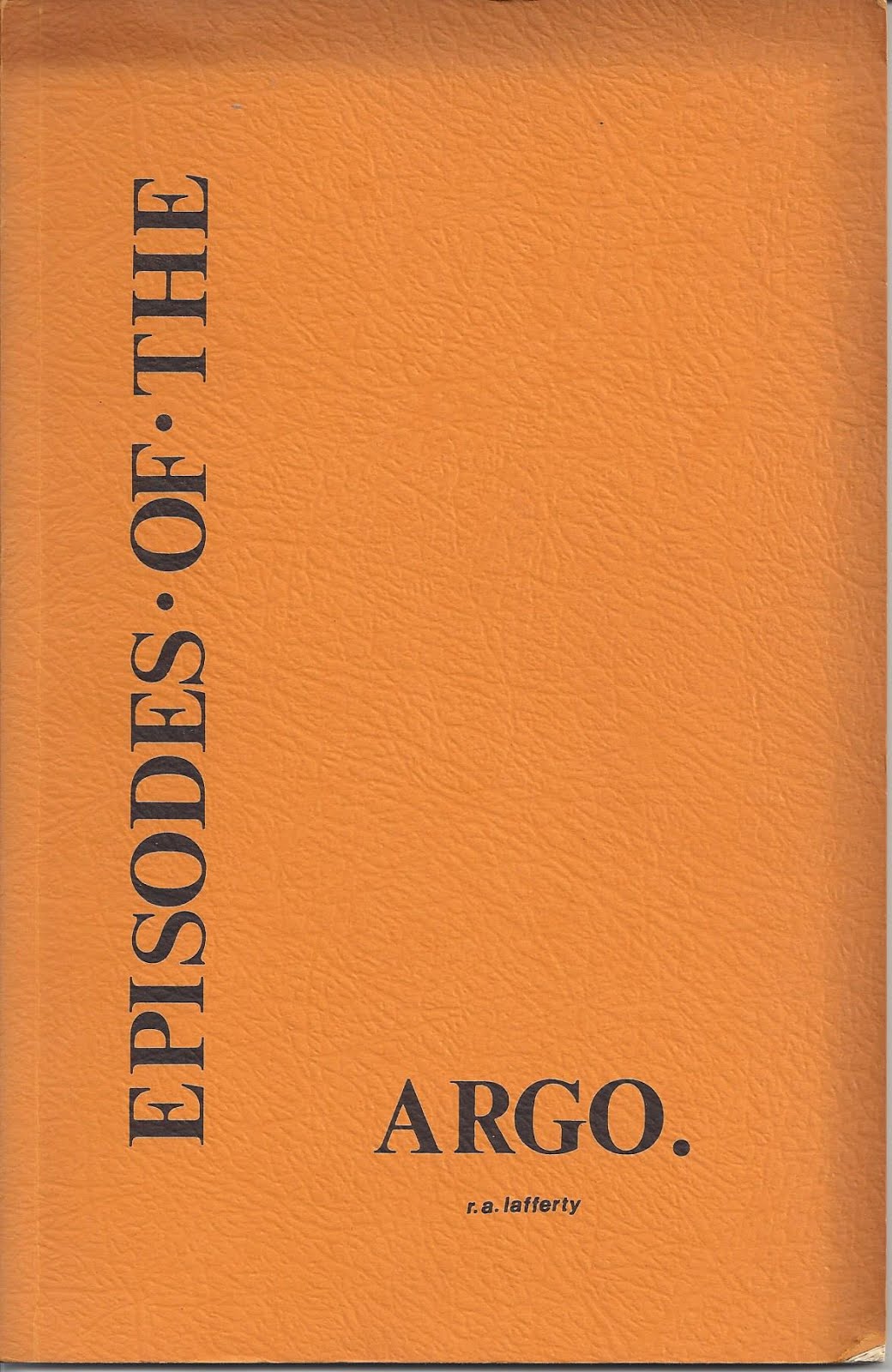
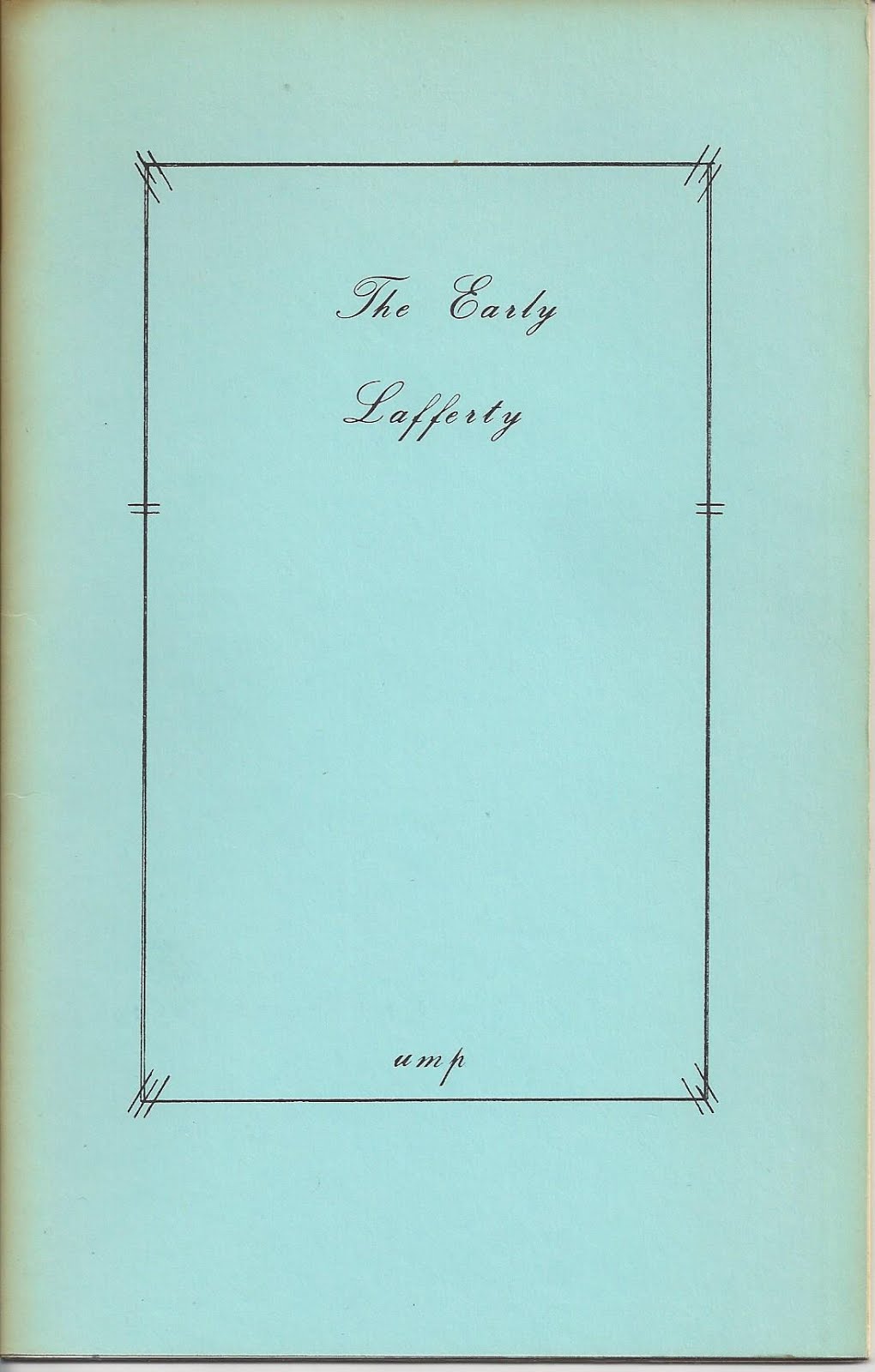
Christmas came a little early for this Lafferty Fan. I just received in the mail today three volumes in good (though much faded and yellowed) condition: Episodes of the Argo, The Back Door of History, and The Early Lafferty. 


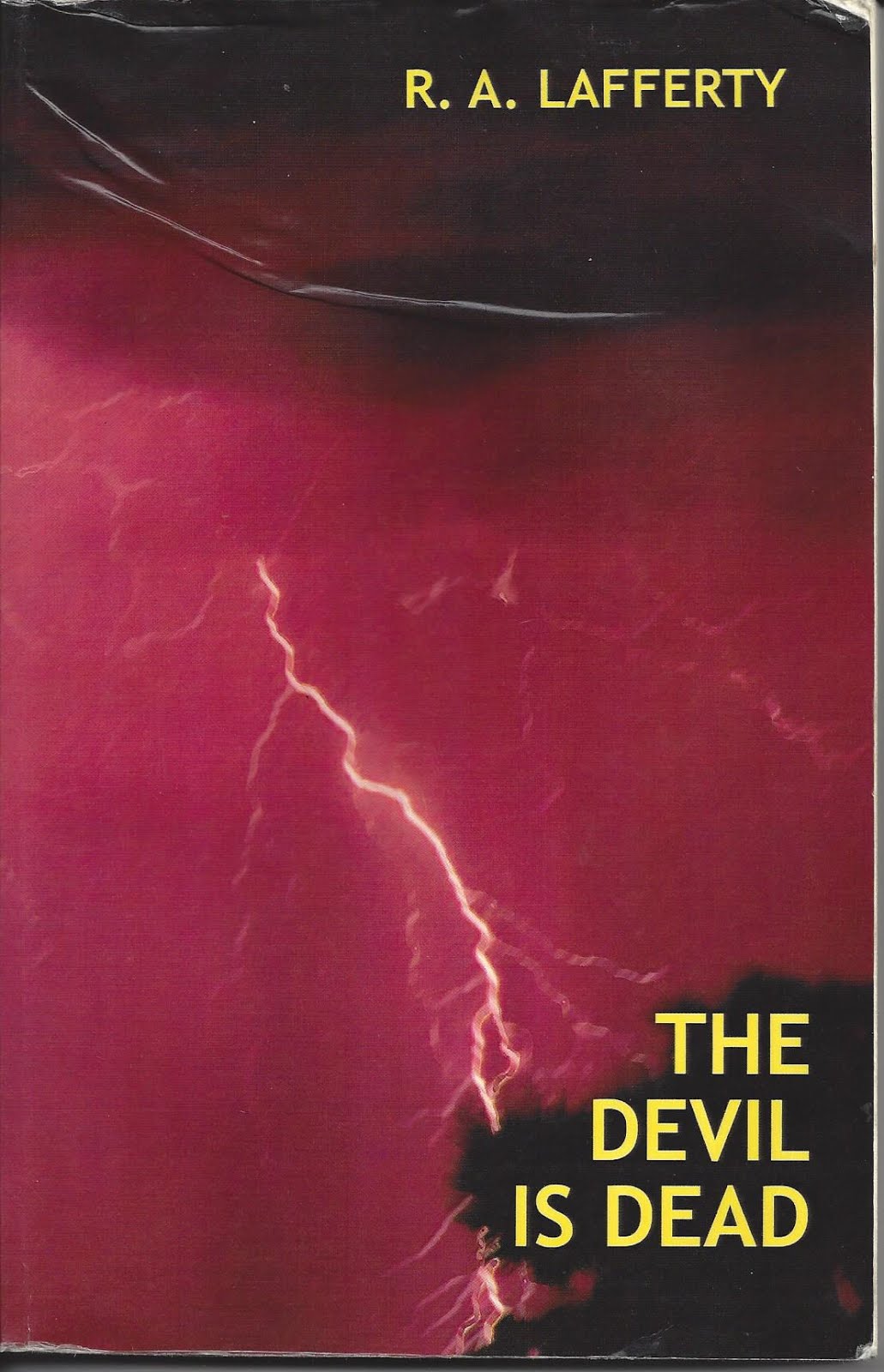
I had to sit over lunch and read some of this bounty, so I read “Apocryphal Passage of the Last Night of Count Finnegan On Galveston Island,” the last story in Episodes of the Argo. It is the concluding chapter Lafferty wrote for The Devil is Dead but did not get to the publisher in time for it to be included in the book. It rather changes my interpretation of the ending--especially a small revelation about the character Doll. The Devil is Dead in most editions of the book ends with a poem by Doll that is cut off in mid sentence, "And they also tell the story of--" This makes a very (nice? cryptic? Joycean?) circular reference back to the Promontia (or introduction) at the beginning, which opens with "And they also tell the story of"

I've always thought that was a deliberate reference to Finnegan's Wake, where the narrative starts mid-sentence and ends with the first half of the sentence that the book starts with. Couple that with the protagonist being named Finnegan and the basic idea that he is loosely (very loosely) based on a proto-Irish folk hero Finn McCool, and I've always assumed that elements of The Devil is Dead were perhaps a deliberate reference to Finnegan's Wake.

I also had finally adjusted to the idea of Doll as standing in for Humanity, and questioning why the Neanderthals were battling each other over the fate of Humanity without ever considering whether or not the Humans would like a say in their own fate. The very last scene winds up with Doll, and by extension the Human race, stealing the show and taking a stand in the battle. In a way, it is a passing of the flag into Human hands. The new(er) last chapter undoes that.
The last chapter "The Apocryphal Passage of the Last Night of Count Finnegan on Galveston Island" reads (to me) like it was written much later, and smacks a little of an author who is too much in love with his creation--Finnegan seems a bit too invincible and too capable in this last chapter, and therefore the tension is missing.
Therefore, my guess is that he wrote this last chapter some time after finishing the book. Perhaps after looking back at it and surmising that he wanted to tie up some more of Finnegan's narrative or perhaps tie it more closely into some of the rest of the Argo cycle.

Monday, November 4, 2013

Roy Mega and Austro - or the Hazards of Reading Lafferty


I have been permanently affected by my reading of Lafferty. I was recently working in the research and development office of a small high-tech company with two young engineers. They are both young grad students, both brilliant and creative and able to do things with electronics that seem like magic. One looks like everyone's image of a clean-shaven mid-western football youth with sandy hair, and the other is slightly darker featured and more bewhiskered. I had trouble with their names at first because in my mind I immediately labeled them “Roy Mega” and “Austro.”

Tuesday, October 15, 2013

Not Getting To Easterwine

Arrive at Easterwine (1971) is one of my favorite Lafferty books. However, I suspect part of what I like so much about it is the sheer challenge of reading it. Here we have a stream-of-consciousness first-person narrative by an unreliable narrator who is not human and has a penchant for speaking in metaphor. Ultimately the entire book is built around a nested 3- and 4-part narrative structure that has the ultimate goal of looking for divine aspects of humanity. It’s a challenge.

I recently lent my copy to a coworker who I view as a very intelligent person. He is a software engineer who occasionally holds forth intelligently on various SF books over lunch, and he has never read Lafferty. Admittedly, it was a bit of a test case--I’ve been reading Lafferty for so long, I’m not fazed by a lot of what puts other readers off. I wanted to see how an intelligent reader would respond to this, one of his more challenging works. I had a few questions in mind:
  1. Near the beginning of the book, Epikt tells us what the structure of the book will be. I didn’t catch that until my third reading of it. Would a reader with a great attention to detail catch that the first time through?
  2. How would the idea of a computer as an unreliable narrator fly with a software engineer whose job is to see computers as logical and uncreative tools? 
  3. How would an intelligent reader respond to the unrelenting layers of metaphor in the narrative?
My co-worker just gave the book back the other day. He didn’t get through it, but said he “gave it the old college try.” Really he did much more than that; knowing how enthusiastic I am about it, he went back and restarted several times, even reading sections of it out loud to his wife. He said the individual sentences were easy, but understanding what had just been said at the end of each passage was baffling. His wife commented that there is obviously deep sense and meaning there, but what it was eluded her. He did not get past the long night of goats and tigers hunting through the buildings housing his memory banks.

He did stumble on the amount of metaphor in the narrative. Just the simple introduction of each person by describing the impression caused by the introduction of their person precis into Epikt’s matrix led to some confusion, and he had trouble keeping the cast of characters straight.

He also stumbled on the idea of an irrational computer. In popular culture, especially in SF, computers are ultimately logical, and their information often infallible. With the notable exception of Hal, computers do not express curiosity or emotion, unless used to comedic effect. Compare the Enterprises computer in Star Trek to Epikt. You have the monotone recitation of detailed data contrasted with conversation with some internal metaphorical Snake that is never fully explained. Epikt’s willingness to dive into metaphor to describe the characters, and his obvious emotional response to their personalities left my coworker a bit baffled, if not shaken.

He did not get far enough into the book to look at its structure.

The book is divided into three sections of four chapters. Each section addresses the theme of one of the three tasks--to find a leader, a love, and a liaison. Even the tasks are metaphorical:
  • Leader = an examination of what leadership means and a question of what state humanity is in and what kind of person could lead it to a better state--perhaps the next step in human evolution. 
  • Love = an exploration of just what the heck love is and an attempt to create universal love among humanity.
  • Liaison = an understanding of the true shape of the universe and by extension, our place within it. 
Each chapter contains episodes centered around the theme of one of the tasks, but they do not form a cohesive single storyline.

So, who is the audience for Arrive at Easterwine? Is it really a book for the hardcore Lafferty fan or for English majors who breakfast on Joyce and lunch on Woolfe? Is it for people who have read Joyce’s Ulysses enough times to understand where the story is metaphor for the human condition, where it is straight narration, and where the interpretation is optional? Yes, all of these, but not only. The one thing this book requires, in my incomplete opinion, is a reader willing to let it wash over them and to enjoy the wordplay without understanding at first. Let the ideas contained within fester in your mind; let them combine and give birth to new little idealets, and then return to it days or even years later. In that manner it can be an immensely rewarding read.

Tuesday, September 17, 2013

Infecting Academia

We all know that Andrew Ferguson is doing perhaps the largest part to bring Lafferty’s work to the attention of the academic world. Here’s the part I’ve played so far in that same struggle:

Arrive at Easterwine: In college, back in the mid ‘80s I took a modern literature class. It was an excellent class--if I remember correctly, we read Dostoyevski’s Notes from the Underground, Kafka’s Metamorphosis, Camus’ The Stranger, Joyce’s Portrait of the Artist as a Young Man, Woolf’s To the Lighthouse, Marquez’s One Hundred Years of Solitude, Hemingway’s The Sun Also Rises, and Steinbeck’s Cannery Row. I wrote my term paper on Arrive at Easterwine forcing a copy of the book into the professor’s hands along with the paper. My paper focused on the stream-of-consciousness elements in the book. He gave me a B or B- on the paper, which I initially blamed on him not liking the fact that it was an SF book and not real “Literature.” However, I really suspect the grade was because I didn’t understand the book very well. It took three readings to really get a handle on it, and that was in the last year (look at my review on Amazon: http://www.amazon.com/Arrive-Easterwine-autobiography-ktistec-machine/dp/068412341X).

Okla Hannali: I’ve ordered evaluation copies from University of Oklahoma Press ($5.00 apiece, including shipping) sent to the teachers in charge of the American Studies programs at the two high schools my children have attended.

Space Chantey: My daughter’s class is studying the Odyssey this year (really a hell of a good 9th-grade English class, their reading list includes Ray Bradbury, Shakespeare, Sophocles, the Odyssey, and The Curious Incident of the Dog in the Night-Time). After much discussion with the teacher, I am lending her my copies of Space Chantey and “Oh Brother, Where Art Thou” which ought to cause an enjoyable bit of cognitive dissonance.

The Flame is Green and The Fall of Rome: After a conversation with the head of the History department at my kids’ school, I am loaning my copy of The Flame is Green and The Fall of Rome to him. I’d love to see Lafferty’s point of view on the relationship between Alaric, Stilicho, and Theodosius get some consideration in a standard world-history class. 

I’d love to hear stories from anyone else who has spread the word to the academic world about Lafferty.